


Jansen Machining Technology employs approximately 75 people and specialises in high-end precision machining. The focus is on customers who impose high demands on accuracy, cleanliness and short delivery times. Products range from small to medium-sized batches, often with complex geometries and tight tolerances. To serve these markets, investing in stable processes and reliable unmanned production is not an option but a prerequisite, according to Twan Bussers, former Managing Director of Jansen Machining Technology. Recently, he has taken on the role of Director Technology for Machining within the Anvil Group, of which Jansen Machining Technology is a part.
150 production hours per week
“The demand for small batches of high-precision, complex components that must meet challenging tolerances and cleanliness requirements calls for a new way of producing. Especially in the high-tech markets such as the semiconductor industry we work for, requirements have increased enormously over the past ten years. At the same time, short delivery times and smaller batch sizes are requested, while margins are under pressure. We therefore aim to run machines in production for 150 hours per week, without producing for stock. To achieve this, you need reliable and accurate machining centres, and processes must be automated and optimised to the maximum extent. That is why we invested in the two five-axis machines from GROB in combination with a flexible automation solution from BMO,” Bussers explains.
Horizontal five-axis machining with GROB
The initial reason for investing in the new production cell was capacity expansion. Due to changed circumstances, it also became a replacement project. A deliberate choice was made to switch to horizontal five-axis machining. “In vertical configurations, chip evacuation is not always optimal and chips often remain in pockets, which creates risks of damage to the workpiece and the tool. In an unmanned production environment, you want to avoid that at all costs. With horizontal machining, chips fall away from the working area, which increases process reliability.”
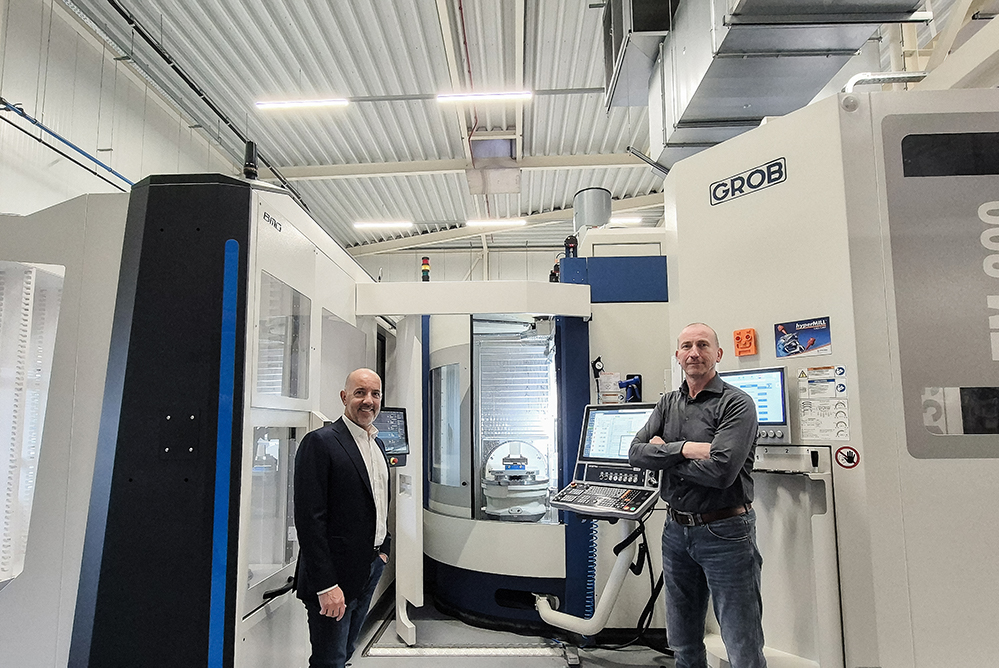
During the purchasing process, two horizontal machines ultimately ended up on the shortlist after a long search. In the end, GROB was selected. “Within our company, someone already had experience working with GROB machines, which strengthened confidence in the brand. In addition, GROB’s machine design played a decisive role in our choice. The robust machine construction and the positioning of the three linear axes minimise the distance between the guides and the cutting point, resulting in high stability,” says Bussers. Iggy Rolando of GROB adds: “An important advantage for Jansen Technology is also the tunnel concept, in which the spindle can move completely within the machine enclosure. This allows even very large components, including when extremely long tools are used, to be machined safely and without collisions within the working area.”
The G350 machines at Jansen are part of the universal machining centres in GROB’s portfolio. The machine has been on the market for many years and has been continuously developed over time. The G350 has working ranges of 600 x 855 x 750 mm along the X, Y, and Z axes and is designed for workpieces weighing up to 400 kg and with a diameter of up to 720 mm.
Stability forms the basis for accuracy
The complete production cell was commissioned in July 2025, and the first workpieces were produced quickly. “We deploy the two GROB G350 machining centres for the production of the most critical workpieces. These include workpieces with tolerances within one hundredth of a millimetre across the entire work envelope, with some dimensions produced to an accuracy of a few micrometres.”, emphasizes Bussers.
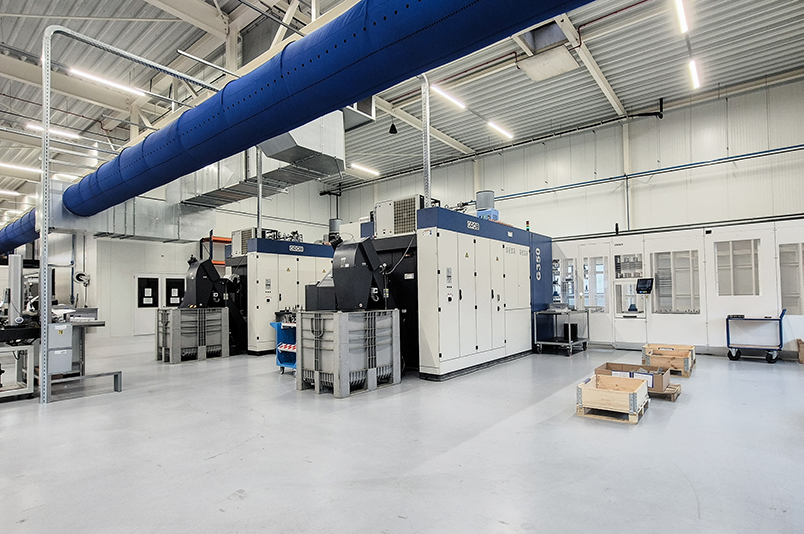
According to Bussers, this is precisely where GROB distinguishes itself in terms of stability and repeatability, which together form the basis for successful unmanned high-mix, low-volume production. To reproducibly achieve these high accuracies in an automated setting, not only do the mechanical and thermal stability of the G350 ensure optimal performance, but also the fully climate-controlled production environment and the coolant that is actively kept at temperature. “To be able to produce this level of accuracy reproducibly, the entire process must be under control.”, explains Bussers.
Automation for high-mix, low-volume
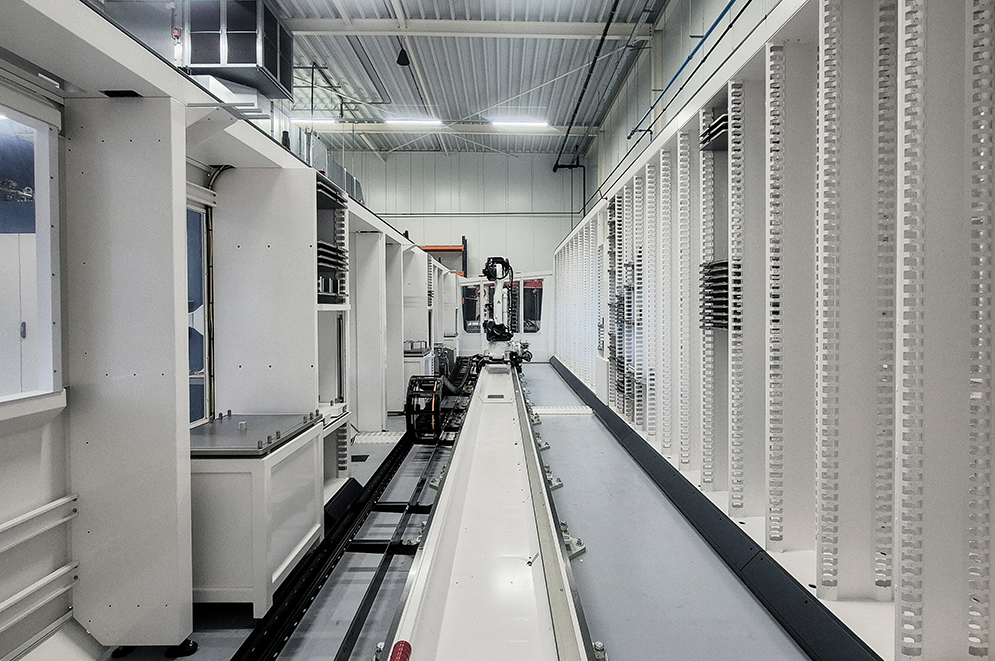
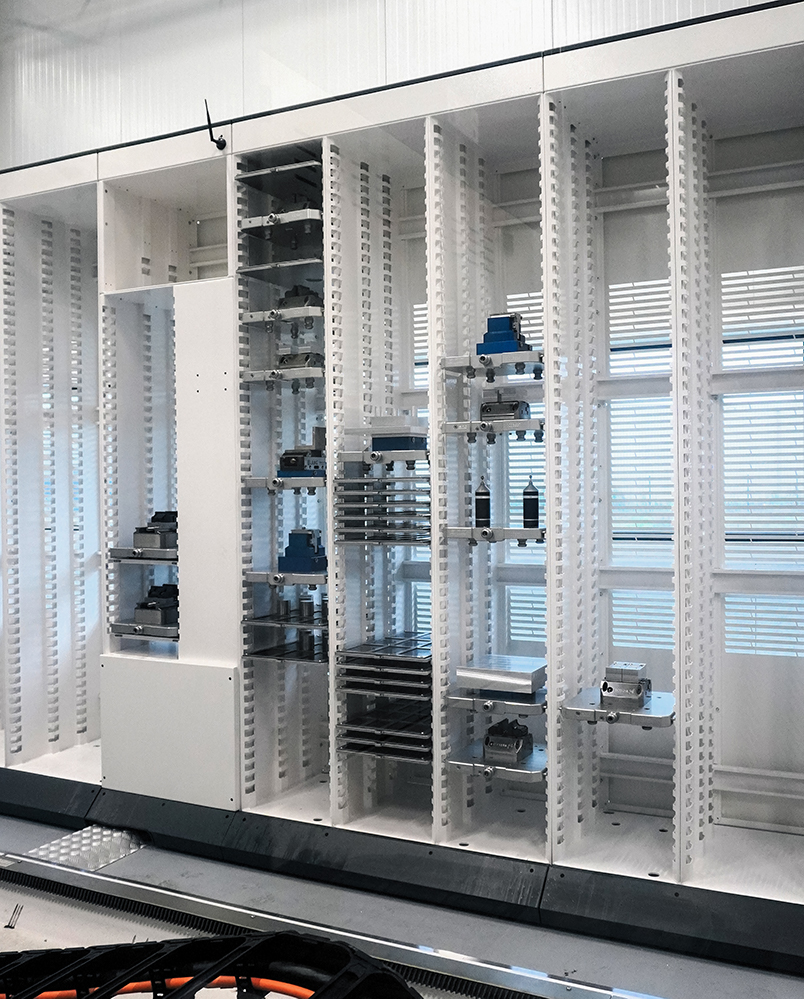
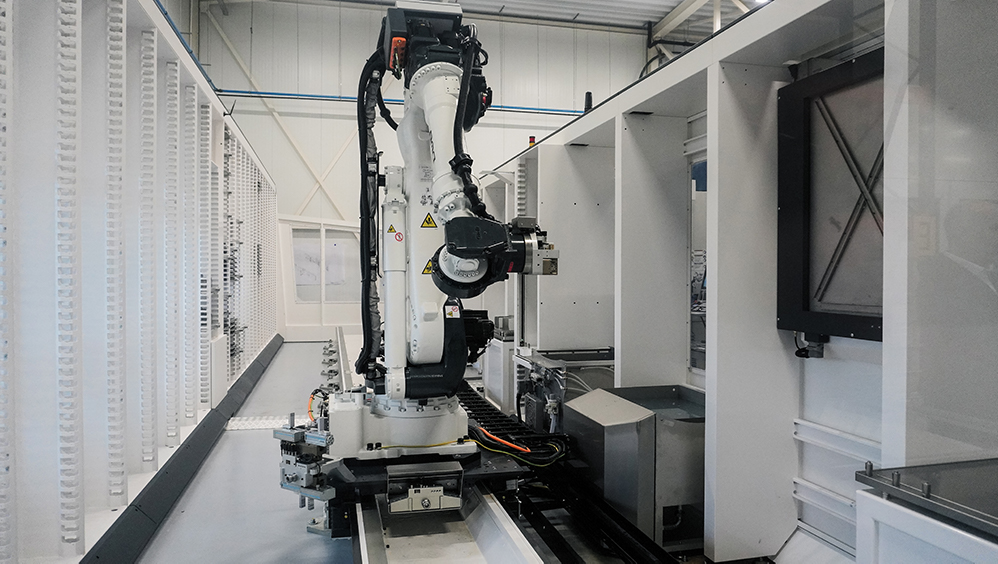
Jansen Machining Technology has connected the two GROB machines to a large-scale automation system from BMO Automation. The cell combines pallet and product handling and is designed for maximum flexibility, allowing a wide variety of products to be produced intermixed.
The cell is equipped with a robot that, via a track system, handles pallets and workpieces between the various machines and stations. In addition to the two GROB machining centres, the cell also contains a cleaning bath to clean workpieces immediately after production and blow them dry to prevent build-up of coolant residues. It is also possible to automatically rotate workpieces, so that the sixth side of the workpiece can also be produced unmanned. A key component for this is an electrically actuated clamping system that automatically adjusts itself to the dimensions of the workpiece. The cell is also prepared for the addition of a third machine, making future expansion relatively easy to realise.
“The integration of the two machining centres and the automation cell went flawlessly. GROB and BMO handled this project jointly and delivered it in working order. We are extremely satisfied with that, and it is of great added value to know that you can rely on it.”, says Bussers happily.
High utilisation rate and repeatability
An important objective of the investment was achieving a high utilisation rate. For profitable automation, the cell must run at least 130 to 140 hours per week, according to Bussers. That is challenging in a high-mix, low-volume environment, but weeks have already been achieved in which these values are met. In practice, a weekend schedule starts on Friday afternoon, after which the machines continue producing unmanned until Monday morning. During the day, the focus is on setup, fine-tuning and logistics. “In theory, with a fully loaded cell we could produce unmanned for several weeks,” Bussers says.
Anvil Group
Jansen Machining Technology is part of the Anvil Group. This group consists of several specialised manufacturing companies, including Job Precision, Rols, De Valk, Slagman, Contour Covering Technology and BKL Engineering. Together, they operate under the name Anvil Industries, with competencies in turning, milling, sheet metal, additive manufacturing and engineering.
The strategy of the Anvil Group is focused on scale and broadening the range of services towards customers. By bundling competencies, the group can take on more complex projects and play a larger role within customers’ supply chains. Project-based collaboration across the various companies is becoming increasingly common. At the same time, there are concrete plans for international expansion towards Asia and North America. Manufacturing forms the foundation in this, supported by VADO, a long-term investor with a clear focus on continuity and technological development.


