


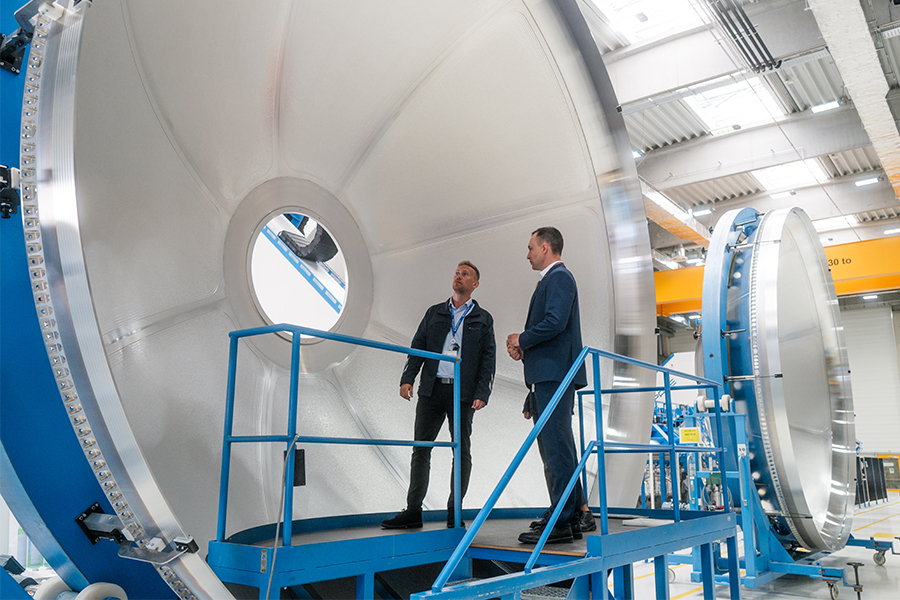
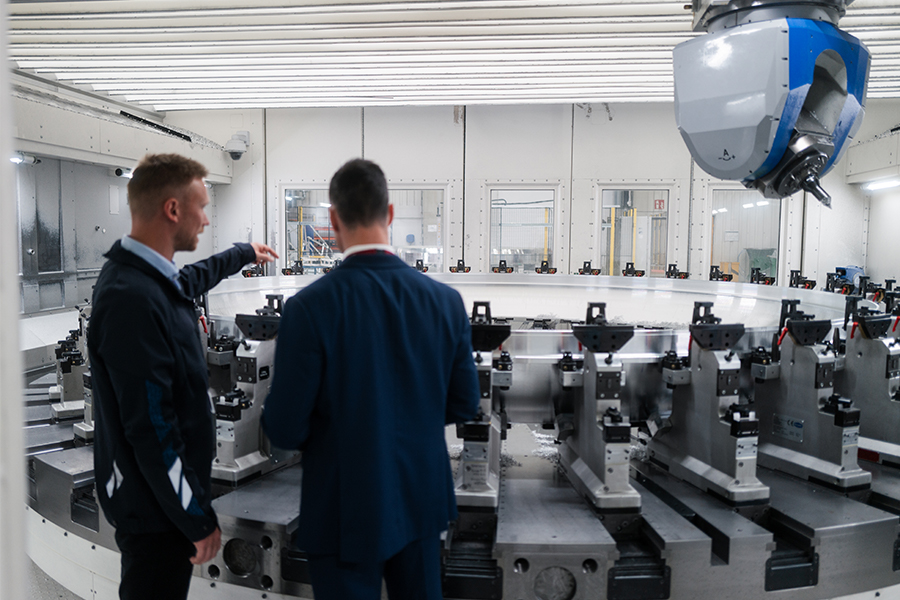
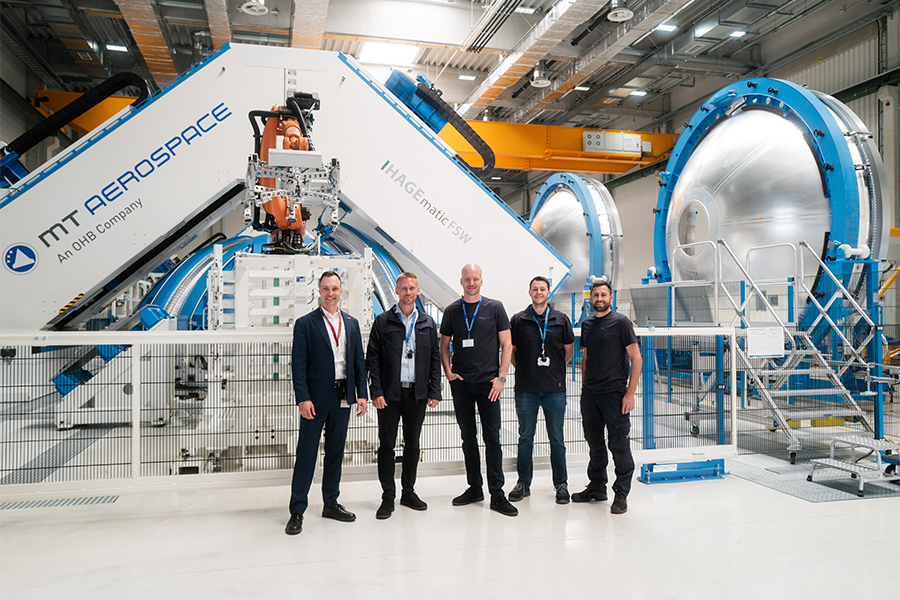
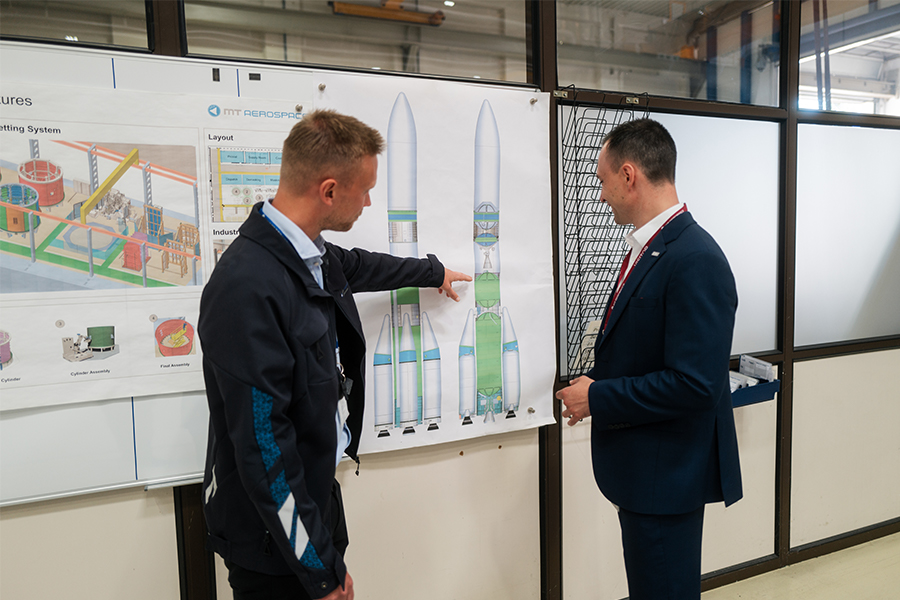
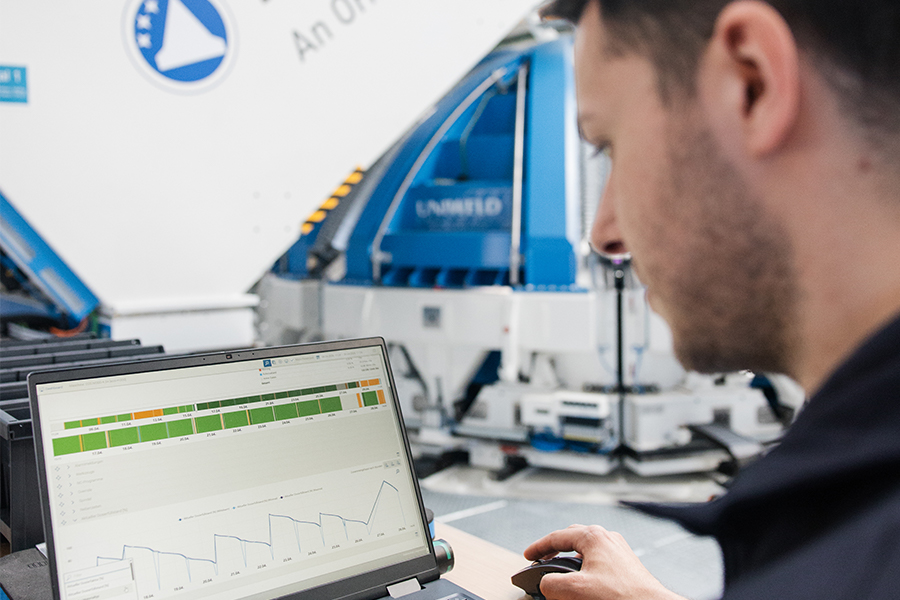
For Tobias Hannen, Engineer for Digitalization of Industrial Processes / Project Manager Space International at MTA, it is clear that this transformation cannot be managed with new machines alone. “In the past, we tended to manufacture small batches. Today, we’re talking about several thousand components per year. This completely changes the requirements. Processes must become more transparent, and our employees must know at all times what tasks are coming up and how they can prepare for them.” To create this transparency, MT Aerospace opted for GROB’s COSERA Manufacturing Execution System—even though the company does not have a single machine from the Mindelheim-based manufacturer in operation.
A System That Fits the Production
When MT Aerospace was looking for a replacement for its existing MES, there were several vendors to choose from. The existing system no longer met the requirements of the growing production. The company was therefore looking for a solution that would integrate seamlessly into the existing system landscape while offering sufficient flexibility for future requirements. “We looked at several providers,” recalls Tobias Hannen. “In the end, the deciding factor for us was that GROB understood our processes very quickly. During our discussions, we didn’t have to spend a lot of time explaining the challenges we faced. It was immediately clear that they possessed manufacturing expertise.”
Another advantage was the tight integration with SAP. Modifications to work plans or additional work steps are applied directly, without the need to maintain information multiple times. “That’s exactly what we wanted to achieve. When something changes in SAP, that information should reach the operator immediately. That saves time and prevents misunderstandings,” says Hannen.
The fact that GROB uses the software in its own production and that the MTA project team was able to visit reference customers gave them even more confidence. “It was important for us to see the system in action, not just in a presentation. At the reference customer’s site, we were able to speak with the users and see how COSERA is used in everyday operations. These insights were invaluable in helping us make our decision,” says Hannen.
Traceability Is Not an Option, but a Requirement
The aerospace industry imposes the highest standards for quality and documentation. Nearly every component manufactured at MT Aerospace has a unique serial number. Every processing step must be fully traceable. “Our customers expect complete traceability,” explains Hannen. “We must be able to say at any time which employee worked on which component and where that component was later used.”
GROB was able to deliver exactly this level of transparency. With COSERA, all the information is centrally available to MTA. “Today, we can see at a glance where an order is in the process and whether there are any delays. In the past, we had to search through paper job tickets to find this out,” recalls Hannen.
From Gut Feelings to Real-Time Data
With MT Aerospace’s rising production volumes, it is no longer sufficient to track production status via paper work orders or individual status updates.
Today, a glance at COSERA’s production monitoring system is all it takes. “We can see in real time where our products are, what their status is, and whether any deviations are occurring. This allows us to react much more quickly,” says Alexander Müller, Production Manager for Large Tank Manufacturing at MTA.
Today, downtime between individual operations can also be analyzed with precision. This allows MT Aerospace to identify early on when bottlenecks are developing or when backlogs are beginning to form in specific areas. “We can see very clearly where products are getting held up and at which piece of equipment a bottleneck is developing. This enables us to take corrective action before the delays affect the entire production process,” says Müller.
Information Where It’s Needed
Digitalization benefits not only production managers but, above all, the employees working at the machines. In the past, they often had to switch between different programs to access drawings, bills of materials, or measurement data. Today, COSERA consolidates all information directly within the job order.
Marco Diener, a machine operator for the FSW welding system at MTA, describes the difference in his day-to-day work as follows: “When I arrive at the system in the morning, I can immediately see what tasks are pending and which components will be processed next. Drawings and work instructions are stored right there. In the past, you had to open several systems to access this information.”
Feedback can also be recorded much more quickly thanks to COSERA.
“Today, I can log machine times or setup times with just a few clicks. That saves time and makes the work easier,” says Diener.
Monitoring Machines Instead of Waiting for Malfunctions
In addition to production control, MT Aerospace also uses GROB’s machine data acquisition system. This ensures that the status and performance data of the machines are available at all times. Programs can be analyzed, feed rate reductions detected, and idle states automatically reported. This offers significant advantages, especially for unmanned machines. “If a machine stops running at night, the responsible employee automatically receives a message on their cell phone. This allows us to respond immediately rather than hours later,” says Patrick Thurner, Sales & Operations Planner at MTA.
The company has also been able to improve its processes in the field of additive manufacturing. For example, sensors monitor material levels and trigger timely notifications before material runs out or a machine shutdown occurs. “In the past, we often didn’t notice that a machine had stopped until someone happened to walk by. Today, all of this happens automatically,” summarizes Thurner.
Co-developed Rather Than Off-the-Shelf
MT Aerospace had originally planned about two and a half years for the implementation of the new system. Just three weeks after the project began, COSERA was already running on the company’s servers. “We were able to show the system to employees very early on. That was important to us because we wanted to involve them in the project from the very beginning,” emphasizes Hannen.
Following a pilot project in additive manufacturing, the rollout to other production areas proceeded step by step. Throughout the entire implementation, the project teams from MT Aerospace and GROB worked closely together. “We held regular workshops and were able to discuss our requirements directly. Many topics concerned not only the MES but also SAP and our quality management system. It was precisely this openness in our collaboration that helped us a great deal,” recalls Hannen.
Software that works independently of the machine park
The project demonstrates that GROB’s digital manufacturing solutions are not tied to a specific machine manufacturer. MT Aerospace operates a heterogeneous machine landscape comprising a wide variety of manufacturers. COSERA connects these systems and creates a common database. For GROB, this is no longer an isolated case. More and more companies are facing the challenge of scaling up their production from single-unit or small-batch runs to higher volumes. It doesn’t matter which machines are already in place. What matters is transparency across all processes.
Optimally positioned for the future
For Tobias Hannen, the project was never just about implementing new software. The goal was to prepare production for future requirements over the long term. “Anyone selecting an MES system today shouldn’t focus solely on current problems. What’s far more important is the question of where the company wants to be in five or ten years. That’s exactly what should guide the choice of solution,” Hannen emphasizes in conclusion.
With COSERA, MT Aerospace has laid the groundwork for this. Manufacturing has become more transparent, decisions are based on real-time data, and employees can access all relevant information more quickly. These are essential prerequisites for successfully implementing the planned expansion of production.


